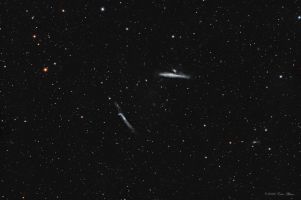
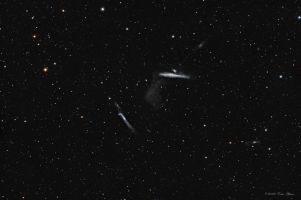
The Whale and the Hockey Stick |
||
 Click on thumbnails below to view larger image. Opens in a new window. |
||
|
||
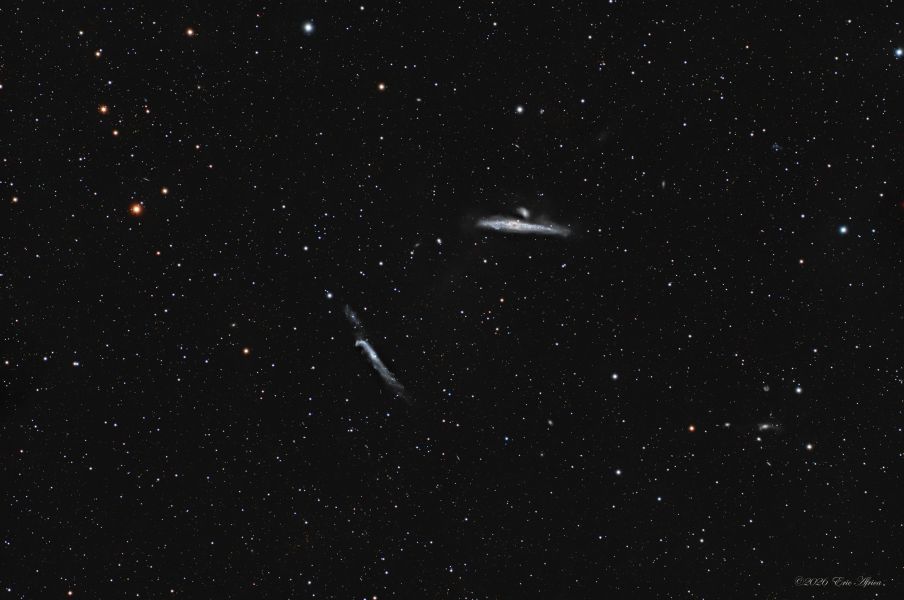
| NGC 4631 (the largest galaxy in this group) is
popularly referred to as the Whale Galaxy and is also catalogued
as Caldwell 32. It is an edge-on spiral galaxy, and its slightly
distorted shape as seen from our perspective is what gave rise
to its nickname. The small galaxy just above NGC 4631 is NGC
4627 is a companion to The Whale and is nicknamed the Pup. Both
objects were discovered by William Herschel on March 20, 1787. The other large galaxy in this image is NGC 4656/NGC 4657 and is referred to as The Hockey Stick (though sometimes the Crowbar) Galaxy. It has two entries in the NGC catalog because John Louis Emil Dreyer saw two separate objects and numbered them accordingly. It was also discovered on March 20, 1787 by William Herschel. The two large galaxies are about a half-million light-years apart (close-by in astronomical terms) and are interacting gravitationally, which explains their distorted appearances. I had been aware of this group of galaxies for a long time but kept putting off imaging either or both of them while "waiting to dial in a longer focal length system". Which I never got around to doing anyway once said system came up. So I finally decided to shoot this area with my current setup, as technologies had advanced to where I can get decent detail and resolution with what was once considered a short-focal-length refractor. That said, as I processed this image I noticed a very subtly brighter region in between NGC 4631 and NGC 4656. I had a brief feeling of excitement as I wondered if perhaps I had discovered some tidal tails (streams of stars) caused by the interaction of the two galaxies. A quick search on the Web determined that no, these tidal tails had already been identified in the past (e.g., https://app.astrobin.com/i/8jp7bn). I am presenting this duo in two formats: one is the image as I originally processed, and the other is the same with the tidal streams exaggerated for easy viewing (and confirmed by other similar images). Note that any "details" in the tidal streams may not necessarily be real (i.e., artifacts from sharpening and/or noise reduction). It would be great if they are actually real, wouldn't it? Another intriguing object in this vista is PGC 42283 (aka UGC 7811), the "little" (farther out) galaxy to the lower right of the main pair. It is described as having an active galactic nucleus, and its shape is reminiscent of a NASA (perhaps Hubble) image leading me to think that this may have a nickname. So far I have not been successful in hunting that nickname down. That said, this object appears to be another interacting galaxy pair, complete with tidal streams and all. |
||
| Constellation:Canes Venatici | ||
| When Visible: March - May | ||
| Distance: 30 Million Light-years (estimated) | ||
| Date: April - May 2026 | ||
| Location: Starfront Observatories, Rockwood, TX | ||
| Exposure Details: L: 120 x 3 Minutes binned 1x1 R: 64 x 3 Minutes binned 1x1 G: 66 x 3 Minutes binned 1x1 B: 64 x 3 Minutes binned 1x1 15.7 hours total exposure |
||
| Equipment Used: Takahashi FSQ-106N on a ZWO AM5N mount. ZWO ASI-2600MM Pro camera with 7 x 50mm filter wheel and Antlia Pro filters. Externally guided with a ZWO ASI224MC camera on a William Optics UniGuide 50 guide scope. | ||
| Acquisition Software : Nighttime Imaging 'N' Astronomy, PHD2 | ||
| Processing Software: MaximDL, PixInsight, Photoshop CS5, IrFanView | ||