
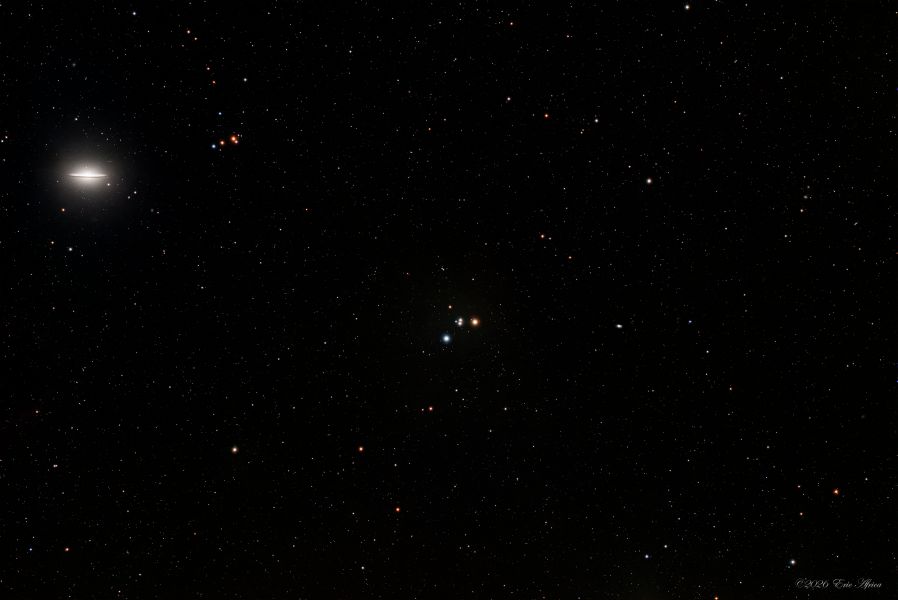
Struve 1659, the Stargate Asterism. And a guest |
 |
| During the springtime season in the northern
hemisphere, the constellation Corvus is visible in the southern
skies. Within this constellation lies an interesting asterism.
This asterism (defined as a pattern or group of stars, which are
more generic than the 88 officially defined constellations) is
catalogued as Struve 1659 or STF 1659. It was noted because of
its interesting shape, being a triangle of stars within a
triangle of stars. STF 1659 was given the nickname the Stargate Cluster, which confused me when I first heard of this object in the early 2000's. Specifically because of the Stargate movie and its TV spinoff series. For the longest time I wasn't sure how a triangle-within-a-triangle cluster got associated with that series. Only recently did I rediscover another stargate from a much earlier TV show: Buck Rogers in the 25th Century, which aired in the US in the late 1970's through the early 1980's! In that series the stargate works very similarly to the stargate of the later series but is depicted as "an equilateral diamond formed by four points linked by thin energy beams" (https://www.buckwiki.com/data/Stargate). What's funny is that I followed that older series but completely forgot about its depicted means of interstellar travel. The STF 1659 designation refers to double stars cataloged by Friedrich Georg Wilhelm Struve (1793-1864) (https://platformx.sourceforge.net/Name/index.html) This target was imaged during a Full Moon period from April through May 2026, following a philosophy I adopted: in a dark sky site during a full moon when narrowband targets are rare, image open clusters. When I composed my image I noticed a relatively large galaxy in the field of view, but decided that the asterism deserved center stage in my composition. Only later on did I realize that the cluster's "photobomber" is actually the popular and photogenic M104, the Sombrero Galaxy! How often does a star cluster take center stage in a composition with a Messier galaxy? Rounding up links to the Stargate series, I kept thinking to myself about an asteroid named Apophis that I imaged in 2021 (here and here). Having watched the Stargate series relatively recently, I found out that one of the principal villains of Stargate SG-1 is named Apophis, after the Egyptian god of chaos, darkness and destruction. On researching that asteroid, I found out that the discoverers of the asteroid are reportedly fans of Stargate SG-1, though they deny that the asteroid was named after the character. That said, while I haven't followed the orbit of that asteroid, my personal fan scenario would be to capture Apophis passing through (in front of, but effectively through) the asterism! Wouldn't that be wild? |
| Object: Struve 1659, the Stargate Asterism |
| Constellation: Corvus |
| When Visible: March - May |
| Distance: 260 - 310 light-years for individual stars |
|
Object: M104, the Sombrero Galaxy |
| Constellation: Virgo |
| When Visible: March - May |
| Distance: 31 million light-years |
| Date: Four nights in April through May 2026 |
| Location: Starfront Observatories, Rockwood, TX |
|
Exposure Details: R = 38 x 3 minutes G = 22 x 3 minutes B = 22 x 3 minutes |
| Equipment Used: Takahashi FSQ-106N on a ZWO AM5N mount. ZWO ASI-2600MM Pro camera with 7 x 50mm filter wheel and Antlia Pro filters. Externally guided with a ZWO ASI224MC camera on a William Optics UniGuide 50 guide scope. |
| Acquisition Software : Nighttime Imaging 'N' Astronomy, PHD2 |
| Processing Software: MaximDL, PixInsight, Photoshop CS5, IrFanView |